
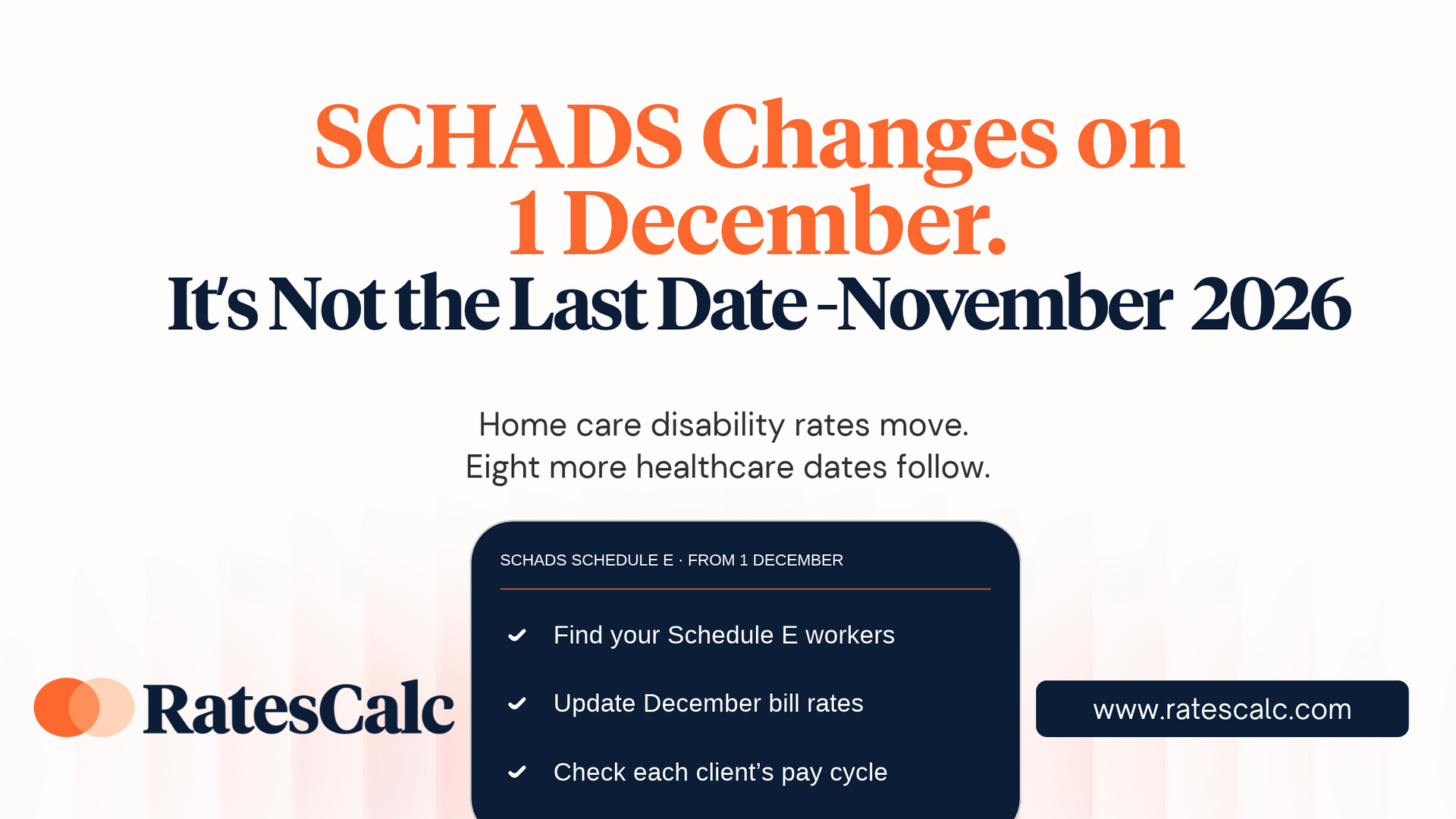
SCHADS changes on 1 December.
It's not the last date.
From the first full pay period on or after 1 December 2026, home care workers doing disability care under the SCHADS Award move to new minimum rates. If you place disability support workers, that's your next pay date. It isn't the last one.
Between the Annual Wage Review, the final stage of the Aged Care Work Value Case and the Fair Work Commission's gender-based undervaluation review, healthcare and care awards have changed, or will change, on nine separate dates between April 2026 and October 2027. 1 July was just one of them.
If you place nurses, allied health professionals, dental assistants, pathology collectors, or aged care and disability support workers, here's the full calendar and what each change means for agencies that pay workers and bill clients at the same time.
Next up: SCHADS Schedule E from 1 December
Home care employees doing disability care, covered by Schedule E of the SCHADS Award, receive an interim increase to their minimum rates from the first full pay period on or after 1 December 2026. For most classifications it is around 15%.
This was originally set for 1 October. In [2026] FWCFB 232 (11 September 2026), the Commission moved it back two months. Employer groups had raised funding: the Commonwealth had committed to funding the aged care increases but not an equivalent for disability support, and NDIS providers needed time to renegotiate service agreements.
What to check this week:
- Which of your placed workers sit in Schedule E, and which sit in Schedules B, C or F. Only Schedule E moves in December.
- Whether client bill rates for December shifts reflect the new pay rates.
- When each client's first full pay period on or after 1 December actually starts. That date is different for weekly, fortnightly and monthly pay cycles.
The calendar at a glance
| Date first full pay period on or after |
Award | What changes |
|---|---|---|
| 1 April 2026 | HPSS | Dental assistants and pathology collectors reclassified, first increase |
| 1 June 2026 | SCHADS | New rules for shifts that include a sleepover |
| 1 July 2026 | All modern awards | 4.75% Annual Wage Review increase |
| 1 August 2026 | Nurses Award | Final Aged Care Work Value Case increase for nurses employed in aged care |
| 1 October 2026 | HPSS | New classification structure and first increase for health professionals |
| 1 December 2026 | SCHADS | Interim increase of around 15% for Schedule E (home care, disability) |
| 1 January 2027 | HPSS | Second increase for dental assistants and pathology collectors |
| 30 June 2027 | HPSS | Next phased increase for health professionals (then each 30 June to 2030) |
| 1 October 2027 | SCHADS | New single classification structure replaces Schedules B, C, E and F |
Health professionals: replaced, not adjusted
From 1 October 2026, the health professional classifications in the HPSS Award were replaced. Level 1 is now set by the AQF level of the profession's standard minimum qualification and four bands of experience in the profession, including time with other employers. Further increases follow each 30 June to 2030, and some AQF Level 5 and 6 rates actually went down.
Old and new classifications don't map one to one, so every health professional needs reclassifying individually. We've covered it in detail here: The Health Professionals Award just changed.
On the support services side, dental assistants and pathology collectors were reclassified from 1 April 2026, with a second increase due from 1 January 2027. Workers already paid above the new rate keep their higher rate.
Aged care: the work value case is finished
The final increase from the Aged Care Work Value Case applied from 1 August 2026, to registered and enrolled nurses employed in aged care under the Nurses Award. Direct care workers under the Aged Care Award and home care workers under SCHADS had already received their final work value increases.
The practical point: nurses under the same award can be on different minimum rates depending on whether they are working in aged care. If your nursing pool moves between aged care and other settings, your rate tables need to know the difference.
The big one: SCHADS from 1 October 2027
From 1 October 2027, a single classification structure replaces Schedules B, C, E and F of the SCHADS Award. Almost every SCHADS worker will be reclassified, and the remaining increases for Schedule E workers land at the same time.
That is eleven months away. Any contract you quote from now for disability, home care or community services work that runs past October 2027 will cross it.
Why this is a labour hire problem
An employer with its own staff updates payroll. An agency updates payroll and every client rate that sits on top of it. Each change on this calendar affects three things at once:
- Margin. If the pay rate moves and the bill rate doesn't, the difference comes straight out of your margin.
- Quoting. Quotes issued now for 12-month health or aged care contracts already cover at least two known increases. Pricing today's rate for a year of work is a margin problem with a delay on it.
- Payroll. Different awards, schedules, settings and pay cycles mean different start dates for the same change. Getting it right across hundreds of placements is where underpayments start.
A practical checklist
- Map every placed healthcare worker to the right award, schedule and classification.
- For HPSS health professionals, confirm qualification level and years of experience are on file.
- Flag every client contract that runs past 1 December 2026, 1 January 2027, 30 June 2027 or 1 October 2027.
- Check what each contract says about passing award increases through to the client.
- Confirm each client's pay cycle so you know when "first full pay period on or after" actually starts.
- Keep a record of when each rate changed and why. If Fair Work asks, that record is your answer.
How RatesCalc helps
RatesCalc tracks award rate changes across the year, not just 1 July, including mid-year work value and gender undervaluation changes. When a rate moves, it updates your pay rates, flows through to compliant client quotes, and keeps an audit trail of every rate decision.
See how RatesCalc handles a mid-year award change in a 20-minute walkthrough.
This article is general information only, current as at November 2026. Always check rates against the Fair Work Ombudsman pay guides for your award.
Click the button below and let’s get started!
