Smart, easy-to-use software

to manage your 

wage compliance and profits

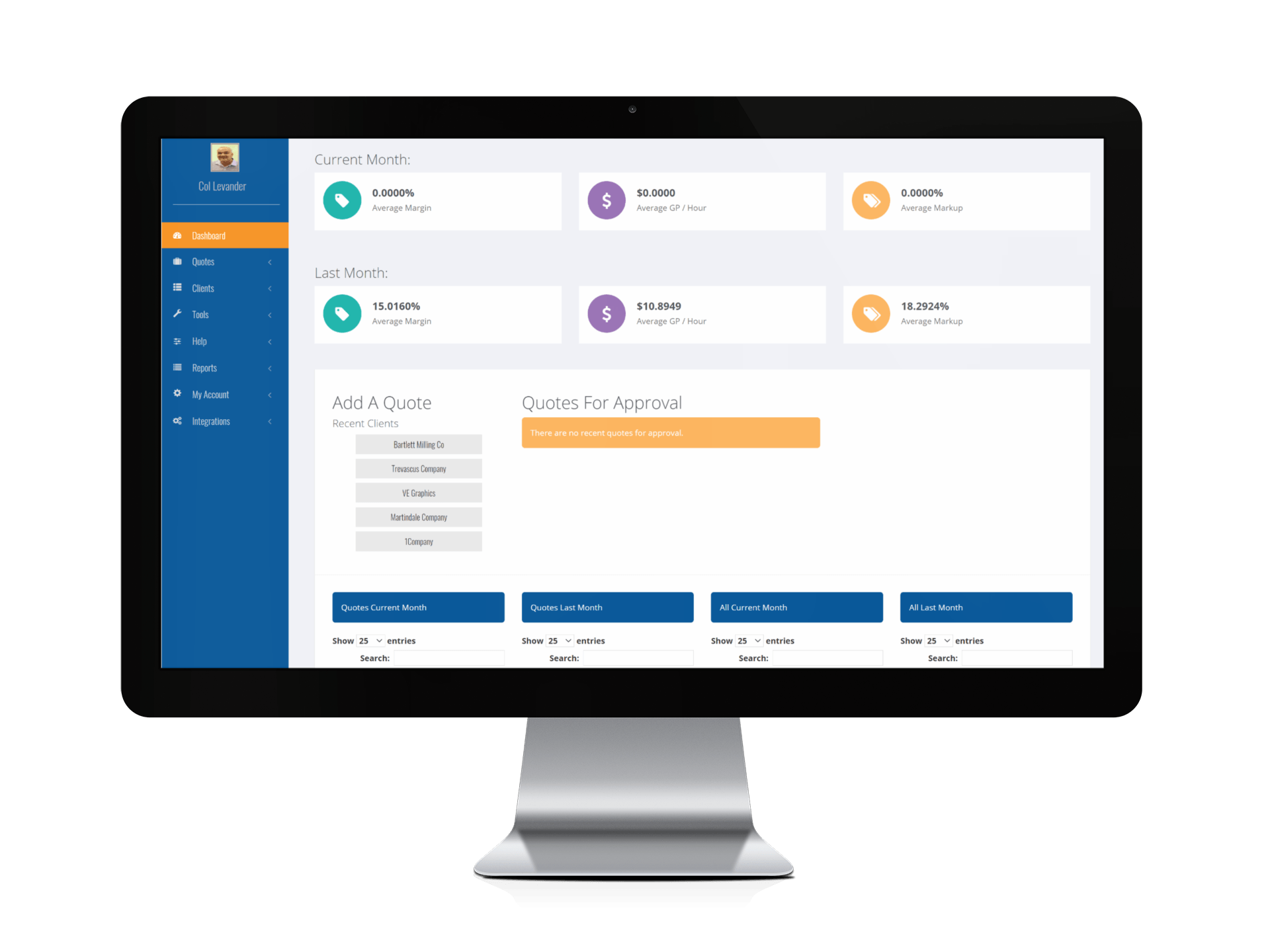
Business compliance software to ensure accurate employee payments, client charge rates and quotes. All at the click of a button!
Book A Free Demo

With all the features you need

Let our secure business compliance technology guide your company’s processes 

Client

Quotes

Prepare and send quotes to your clients from your everyday system in just a few clicks directly from inside the RatesCalc.com platform.

Wage

Compliance

Keep your award pay rates accurate and your business compliant with all industrial agreements, EBA's and awards all in the one platform.

Profit

Margins

Control and maintain Business profit margin erosion to eliminate potential human error with accuracy and peace of mind !

Employment Contracts

RatesCalc.com allows you to generate accurate, compliant employment contracts and receive notifications with updates in real time.

Are you ready for the changes?

Come 1st of July 2026 lots of changes are taking place, from minimum wage changes to phasing out of C12 awards, pay day super and more.

Read our complete guide by clicking below.

RatesCalc is a multi-award winning platform

RatsCalc.com and its business compliance software solution are extremely proud to have won and made Deloitte’s Fast 500 Technology for APAC. Not only did we make the list based on the growth we also came within the top 100. 

Book A Free Demo

How we work

Start with a Demo

Every demo is tailored to your business. Book in and we'll show you RatesCalc working on the awards and classifications that matter to you.

Get set up

Onboarding is straightforward. Your awards, your classifications, your existing systems — we configure RatesCalc around how your business already operates and plug into your ATS.

Run Compliantly

Award rates update automatically after every Fair Work decision. Your quotes are always accurate. Your audit trail is always current. Your team spends less time checking and quoting and more time doing what they are good at.

Ensure Your Business Is Fully Compliant

RatesCalc.com is the worlds only software that can manage compliance and governance for your workforce. Features include managing modern award updates with accurate pay rates to ensure wage compliance across all industry sectors, as well as providing real profit margins management & employment contracts tailored specifically towards any arrangement of work you or your clients manage today or into the future.

Real Support

Hundreds of video tutorials cover every workflow and section in the platform — so most questions answer themselves before you need to ask.

When you do need us: the team runs 7am–7pm Monday to Friday, with after-hours support available depending on your package.

Purpose Built

RatesCalc was built by people who understood the compliance problem before they built the solution.

It's designed specifically for recruitment, staffing and labour hire - not adapted from generic payroll software. Every feature exists because someone in this industry needed it.

Built for Your Business

Every employment type. Every modern award. Simple businesses and complex ones.

RatesCalc adapts to your structure — whether you're running a single-desk agency or a multi-site labour hire operation across several awards and client contracts.

Australian made technology

Our award winning business compliance software Ratescalc and team are very proud of our Australian Made and Owned status. We are one of the few Australian software platforms and we are the only business compliance application to be able to handle awards, pay rates, profit margins, employment contracts, increases and quotes all in one platform. Ratescalc.com truly is software like no other. 
What Our Clients Say About Us

Our clients range from SME to ASX and Fortune 500 companies across every industry sector.

About Us

As an organisation we see RatesCalc for our success for the future and a product that will provide us with a distinct market edge whilst providing peace of mind.

Tom Reardon

CEO People Infrastructure

There are so many efficiencies in using Ratescalc it’s hard to just choose three- but for our business, it must be Contract management, Seamless integration with our other systems, and speed in quoting. I have no issues anymore with simple mistakes by my team and I have Ratescalc to thank for that.

Simon Middlebrook

General Manager - Skillforce

This software is excellent for service-based companies that ‘On-Hire” contingent workforces and provides accurate quotes and employment schedules easily. It’s easy to use, has validation mechanisms in-built to ensure you get it right every time!

Glenn Genrich

General Manager NSWBC

You will not find a better software solution on the market. Ratescalc understands employment and have lived and breathed our pain points as professionals and in turn created maximum business efficiencies to empower compliance and in turn our bottom line.

Sally Sage

KM Community & Work Ready Resources

Latest Blog Posts

July 29, 2026
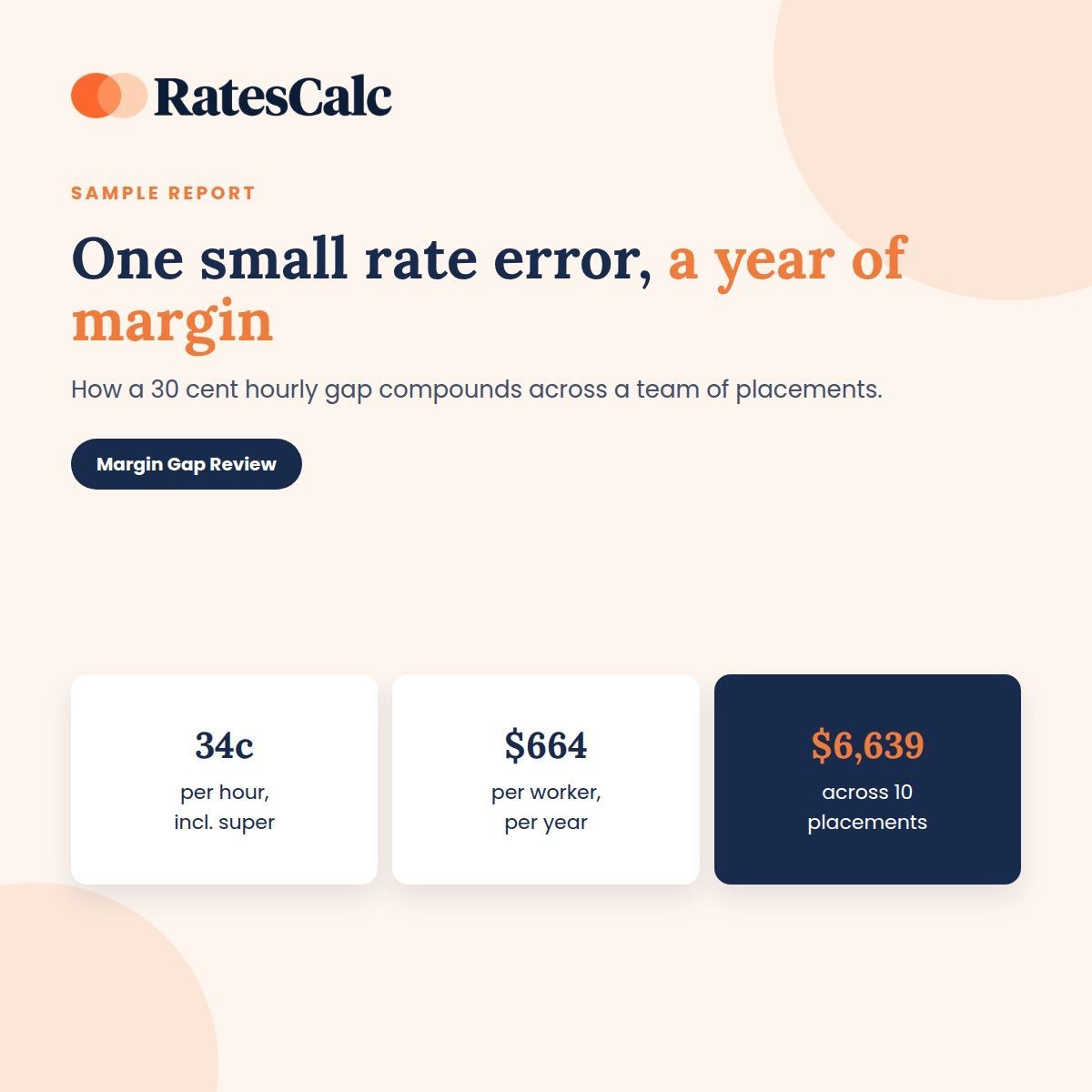
The Annual Wage Review 2026 decision took effect from the first full pay period on or after 1 July 2026. By now most businesses have run at least two pay cycles under the new rates. The rate change itself is done. This is exactly when underpayments start accruing quietly. The pattern is consistent after every wage review. A business updates the base hourly rate in payroll, confirms the new figure against the Fair Work Commission decision, and considers the job finished. What it hasn't done is check the fifteen or so other numbers that are calculated from that base rate — and those are where the shortfalls sit. Individually they're small. Multiplied across a workforce and left to run for a quarter, they stop being small. If you employ under a modern award, this is the check worth running in the next fortnight, before the error window widens. What actually changed on 1 July The Fair Work Commission handed down its Annual Wage Review 2026 decision on 2 June 2026 ([2026] FWCFB 3500). Two things happened: A 4.75% general increase to all modern award minimum rates. An additional 1.25% structural adjustment for C13 and C14 classifications, forming part of the phased adjustment of the C13 rate. For workers in those classifications, the total movement is 6.00%, not 4.75%. The new C13 rate is $26.44 per hour. The new C14 rate is $25.74 per hour. Around 2.8 million workers are covered, across more than 120 modern awards. That second point is where the first error commonly appears. A single percentage applied uniformly across a rate table will underpay every worker on C13 and C14 rates by 1.25%. On a full-time equivalent, that's a shortfall that compounds across ordinary hours, overtime, leave accruals and superannuation — and it applies to the workers least able to absorb it, which is precisely the profile that attracts regulatory attention. The cascade: what moves when the base rate moves Modern awards are built as a structure of derived rates. Almost nothing in an award is a standalone number. Change the base and the following elements should change with it: 1. Ordinary hourly rate. The obvious one. Usually the only one that gets updated automatically. 2. Casual loading. Typically 25% under most awards, calculated on the new ordinary rate. If your payroll stores casual rates as fixed dollar values rather than as a calculation, they will not have moved. 3. Overtime rates. Time and a half, double time, and any award-specific variants — all calculated on the new base. Check whether overtime is computed dynamically or drawn from a stored rate table. 4. Penalty rates. Weekend, public holiday, evening and early-morning penalties. Same issue: dynamic calculation versus stored values. 5. Shift loadings. Afternoon, night, permanent night and rotating shift loadings, each with its own percentage under the relevant award. 6. Casual overtime and casual penalties. The compounding question — whether loading and penalty are calculated on the base or on the loaded rate — varies by award. If you got this wrong before 1 July, the increase has now magnified the error. 7. Annual leave loading. Usually 17.5% of the ordinary rate, so it moves with the base. 8. Percentage-based classifications. Junior rates, apprentice rates and trainee rates are expressed as a percentage of an adult classification rate. They move automatically only if your system holds them as percentages. 9. Higher duties and mixed-function rates. Where an employee performs work at a higher classification for part of a shift. 10. Superannuation. The superannuation guarantee is calculated on ordinary time earnings. A higher ordinary rate means a higher SG obligation. An underpaid wage produces an underpaid super contribution, which is a separate liability with its own consequences. 11. Notice, redundancy and termination payments. Calculated on the applicable rate at the time of termination. 12. Annualised wage arrangements and salary set-offs. Where an award permits an annualised salary in satisfaction of award entitlements, the arrangement must still leave the employee no worse off. A 4.75% movement in the underlying rates can push a previously compliant salary below the required outer limits. This one is routinely missed because the salary figure itself doesn't change — so nothing appears to have happened. 13. Enterprise agreement rates. An EA cannot pay less than the relevant award minimum. Where EA rates were set with a modest buffer above the award, an increase of this size can erode or eliminate that buffer. The allowance trap Allowances need separate handling, and this is where a well-intentioned bulk update creates a problem. Awards contain two broad categories of allowance: Wage-related allowances — leading hand, first aid, industry allowances, and similar — are typically expressed as a percentage of a standard rate and move with the wage increase. Expense-related allowances — meal, travel, tool, vehicle and laundry allowances — are generally adjusted by reference to the relevant Consumer Price Index figures, not by the annual percentage increase. Applying 4.75% across every allowance line is not a conservative safe harbour. It produces incorrect figures, breaks your reconciliation, and makes it harder to demonstrate that you calculated anything deliberately. Each allowance needs to be taken from the current award text. Where the errors actually originate In practice, post-review underpayments come from four places. Payroll configuration . Systems that store derived rates as static values rather than calculating them from the base. The base updates; the derived rates don't. Nothing errors, nothing flags, and payslips look normal. Rate spreadsheets . The parallel set of numbers that operations and account managers actually work from. Payroll gets updated on time; the spreadsheet in the shared drive doesn't, and it's the spreadsheet that drives quoting and client rate cards. Client rate cards and contracts. For agencies, this is the commercial version of the same problem. The pay rate goes up on 1 July; the charge rate agreed with the host doesn't move until someone renegotiates it. That's a margin problem rather than a compliance problem — but it becomes a compliance problem when someone under pressure decides to hold the pay rate down to protect the margin. Classification drift. A worker's duties change and the classification doesn't follow. The wage review makes this worse, because the gap between the classification you're paying and the classification you should be paying widens with every increase. The check to run this fortnight Work through this against a sample of at least five employees, chosen to cover casual, permanent, shift-working and overtime-working profiles: Confirm the base rate against the current award text — not a summary, not a secondary source. Fair Work's pay tools and the award itself are the source. Confirm C13 and C14 workers received 6.00%, not 4.75%. Recalculate one overtime shift, one weekend shift and one public holiday shift manually and compare against what was actually paid. Check casual loading is calculated on the new ordinary rate. Check every allowance line against the current award — separating wage-related from expense-related. Recalculate superannuation on the corrected ordinary time earnings. For anyone on an annualised salary, run the reconciliation against the new award rates rather than assuming last year's outcome still holds. Confirm any enterprise agreement rates still sit above the new award minimums. If any of those checks produces a variance, the important question isn't just how much — it's how far back, and whether the same error affects everyone in that classification. If you find a shortfall Move quickly and document what you do. Calculate the full amount owed, including superannuation. Back-pay it immediately. Keep a written record of what the error was, when it was identified, how it was calculated and when it was rectified. That record matters more than employers tend to realise. Since 1 January 2025, intentional underpayment of wages can be a criminal offence. Honest mistakes are not captured by that offence — but the distinction between an honest mistake and something else is drawn on evidence, and the evidence is your documentation and your process. An error found by your own review and fixed within a pay cycle looks materially different from the same error found by an inspector two years later with no record of anyone having looked. The underlying issue Most businesses aren't getting this wrong through carelessness. They're getting it wrong because award interpretation is genuinely difficult, the derived rates are numerous, and the tools most agencies use — payroll systems built for a single employer, and spreadsheets built by someone who has since left — were never designed to hold 120-plus awards and re-derive every dependent rate when the base moves. That's the problem RatesCalc was built for. Award rates update automatically at the source, every derived rate recalculates from the current award text, and every rate decision carries a timestamped record of what was applied and when. Run a post-1 July rate check. 
June 23, 2026
The Fair Work Commission confirmed a 4.75% increase from 1 July — but C13 workers receive 6%. Full guide with rate tables, sourced from the FWC decision.
July 11, 2025
Are you as profitable as you think? Discover the silent margin erosion affecting recruitment businesses — and what to do about it.
Show More

Book your free demo with RatesCalc

Book your free demo with RatesCalc

Click the button below and let’s get started!

Book A Free Demo