The Fair Work Commission handed down the Annual Wage Review 2026 on 2 June 2026. The headline is 4.75%. However for employers in recruitment, labour hire, hospitality, retail, manufacturing and a dozen other sectors, the full picture is more complex and more consequential than a single percentage suggests. This guide covers everything you need to know, with every figure sourced directly from the FWC decision.
A glance at the changes.
This is paragraph text. Click it or hit the Manage Text button to change the font, color, size, format, and more. To set up site-wide paragraph and title styles, go to Site Theme.
The 4.75% increase - what it covers and who it affects.
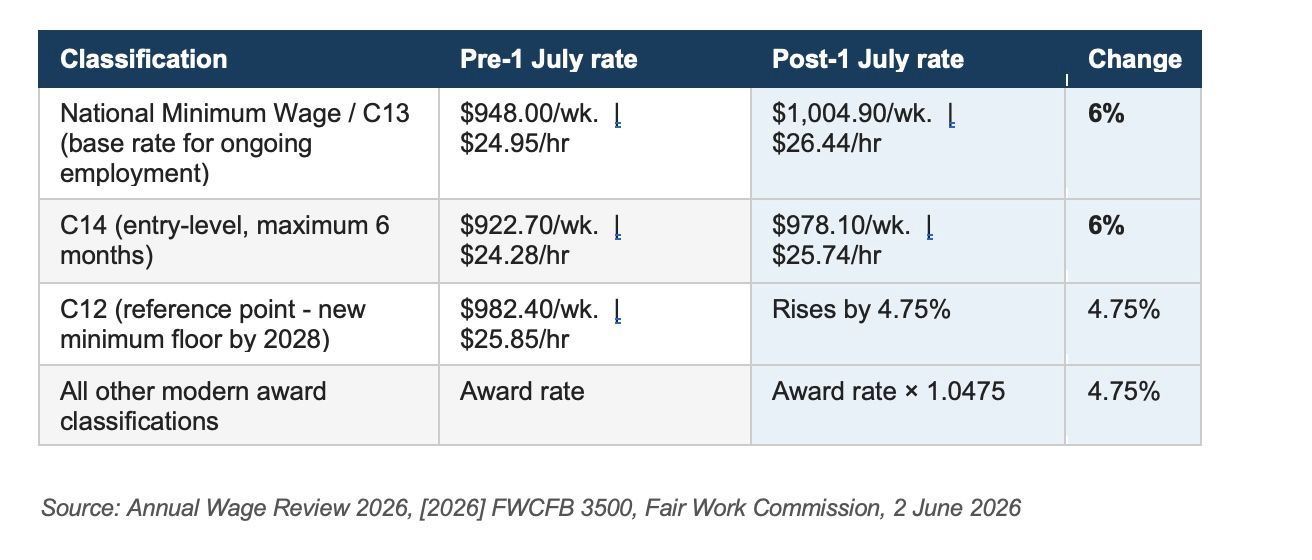
On 2 June 2026, the Fair Work Commission handed down its Annual Wage Review decision. The principal determination is a 4.75% increase to all modern award minimum wage rates, effective from the first full pay period on or after 1 July 2026.
This increase applies across all 120+ modern awards in the national system. Approximately 2.8 million employees - 21.1% of the Australian workforce are paid at an applicable minimum wage rate under a modern award and are directly affected.
Who is most directly exposed?
The FWC identified four industry divisions that account for over two-thirds of all modern award-reliant employees:
- Accommodation and food services
- Retail trade
- Administrative and support services
- Health care and social assistance
For employers in recruitment and labour hire - who place workers across many of these sectors simultaneously — the 4.75% increase flows through to every active placement, every quoted rate, and every contract priced on award rates. The compliance obligation is not singular. It is multiplied across every worker, every award, and every client engagement.
The increase applies to base rates. Casual loading, penalty rates, allowances and overtime are then calculated on top of the new base — meaning the dollar impact compounds upward through the full employment cost structure.
Effective date: The increase applies from the first full pay period on or after 1 July 2026. If your business runs fortnightly pay cycles, the new rates must apply from the first full fortnight that begins on or after 1 July - not necessarily from 1 July itself. Check your pay period start date.
The C13 structural change - the story inside the headline
The 4.75% general increase is the headline. But it is not the whole story.
Alongside the general increase, the FWC made a structural adjustment to the two lowest classifications in the modern award system — C13 and C14. Understanding this adjustment is essential for any employer with workers at or near the award minimum, and for any recruitment or labour hire business quoting on those rates.
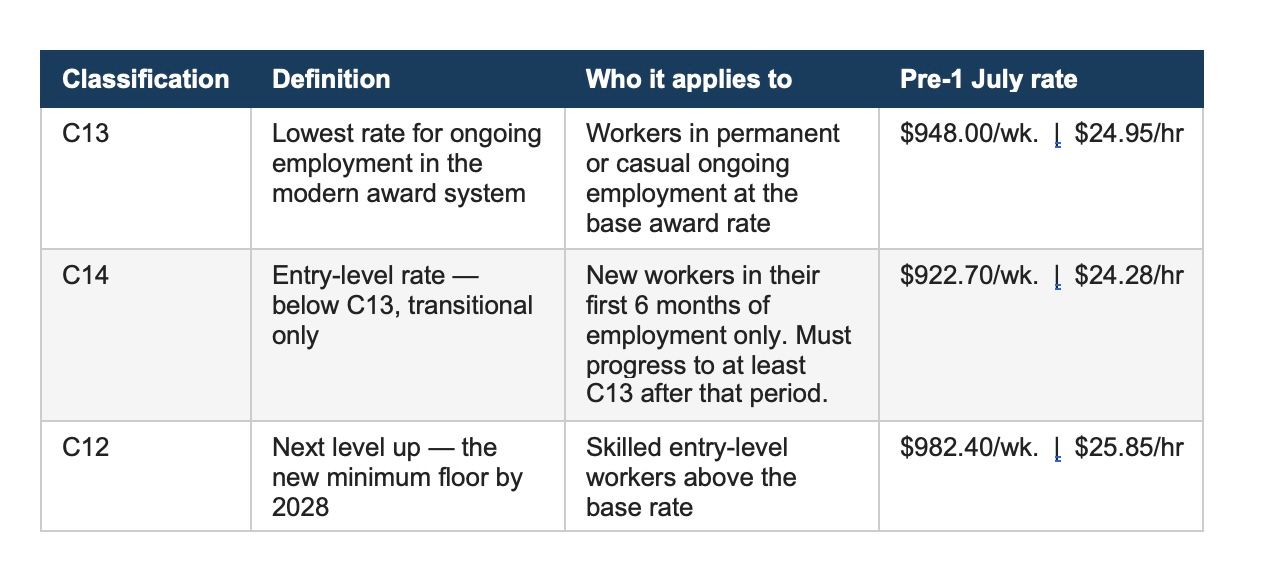
What are C13 and C14?
Modern awards use a classification hierarchy, a numbered scale that reflects skill levels and experience. The C classification scale originated in the Manufacturing and Associated Industries Award but its rates serve as reference points across the broader award system.
C13 and C14 classifications or their equivalents under different naming conventions - appear across many awards beyond manufacturing. Equivalent entry-level and base-rate classifications are found in the Hospitality Industry Award, the General Retail Industry Award, the Cleaning Services Award, the Horticulture Award, and dozens of others.
RatesCalc calculates your true labour cost automatically - every award rate, loading and allowance, updated after every Fair Work decision. Book a 15-minute demo
What the Commission decided about C13
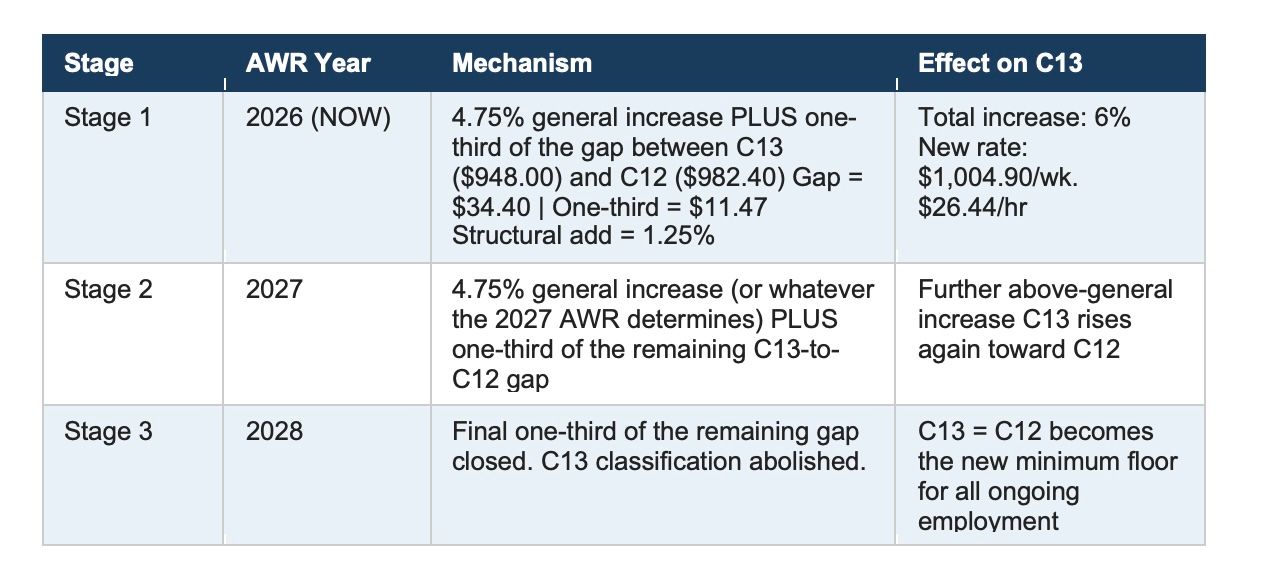
The FWC determined that the gap between C13 and C12 is too wide - that the lowest ongoing employment rate in the system sits too far below the next level up. It has decided to close that gap progressively, over three Annual Wage Reviews:
This is a three-year structural reform. The C13 classification will not exist after the 2028 Annual Wage Review. For employers with workers at the base award rate, this means above-general increases at each of the next two Annual Wage Reviews — not just this one.
The maths - shown plainly
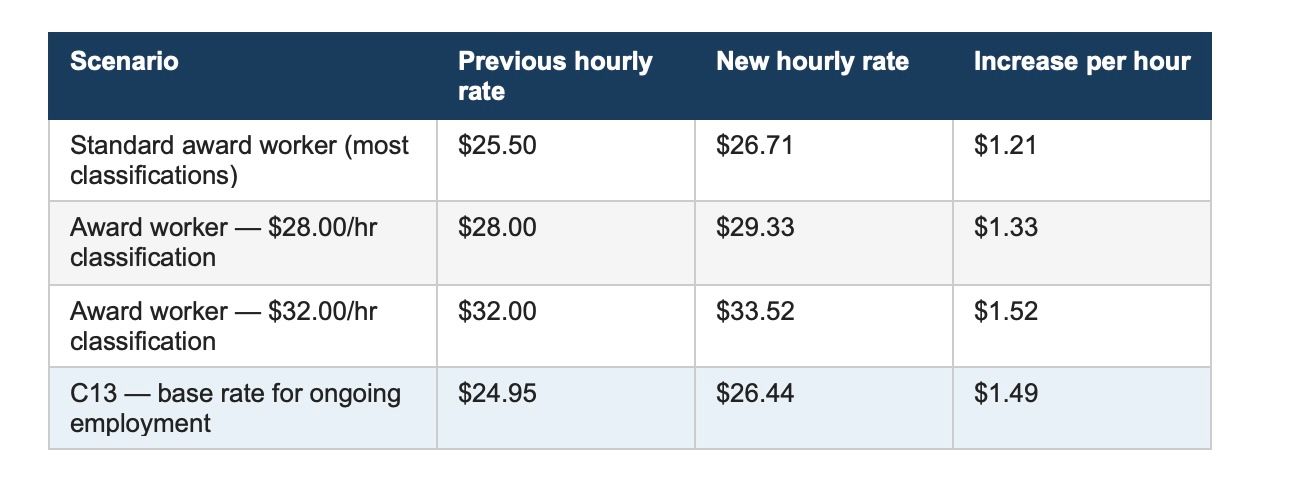
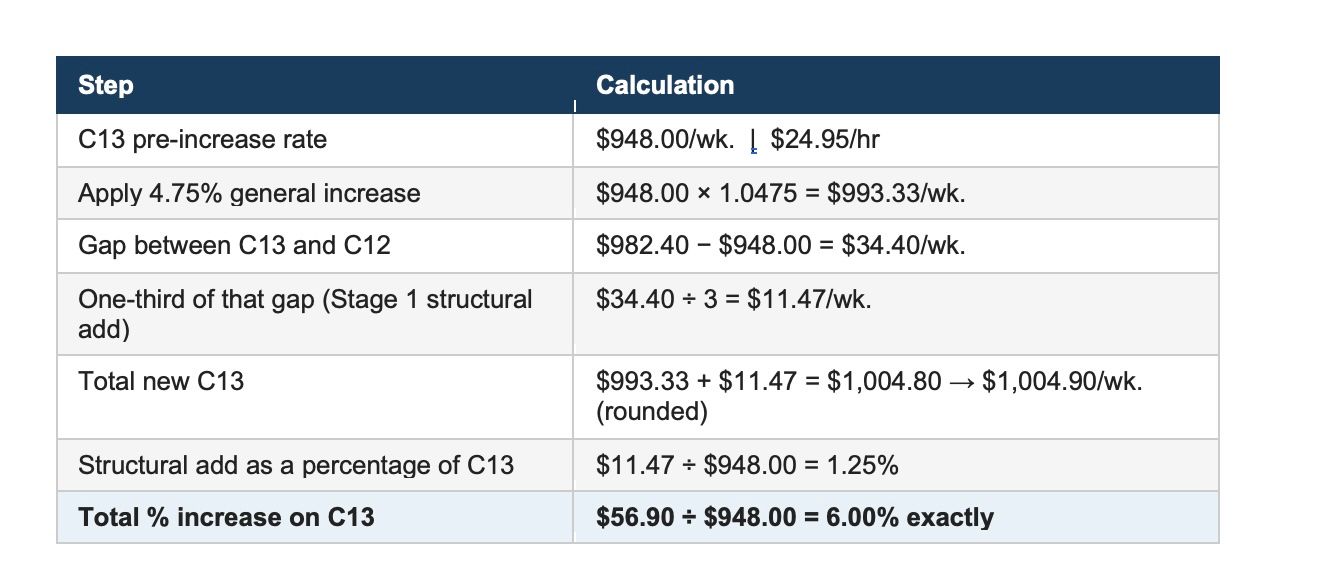
The mechanism the FWC used to calculate the C13 increase is straightforward:
What about C14?
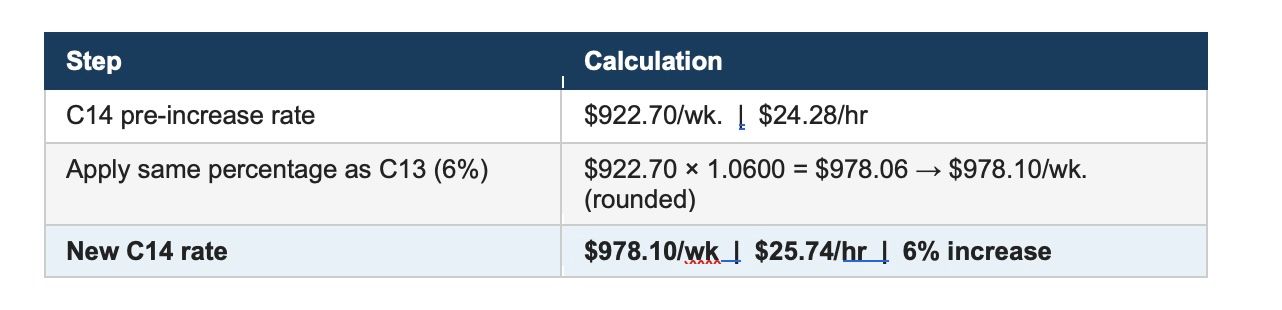
The FWC decision is explicit: C14 rises by the same percentage as C13. This is to maintain its current relativity to the C13 rate.
IMPORTANT: C14 does NOT increase by 6.8% or any other figure. The FWC decision confirms explicitly that C14 rises by the same percentage as C13 — 6%. Any secondary source citing a different figure should be disregarded. All figures in this guide are sourced directly from [2026] FWCFB 3500.
What this means for recruitment and labour hire.
For recruitment agencies and labour hire operators, the 2026 rate changes create a specific set of obligations that go beyond standard payroll compliance. The nature of the business — placing workers across multiple clients, multiple awards, and multiple classification levels — means the margin for error is multiplied.
The quoting problem
Every client quote built on award rates is affected by the 1 July increase. Any quote produced before 2 June 2026 was built on rates that are now out of date. But the problem is more specific than a general rate update:
- A quote built on a flat 4.75% increase for C13-classified workers is $0.36/hr per worker short of the actual obligation
- A quote built on C14 rates for a placement that runs longer than 6 months will face a mandatory reclassification to C13 mid-contract a built-in cost increase the quote may not have accounted for
- A long-term contract (12 months or more) that covers C13-classified workers will face Stage 2 of the phase-out at the 2027 Annual Wage Review another above-general increase before the contract expires
The C14 tenure clock
This is one of the most practically significant and least discussed compliance obligations for labour hire businesses.
C14 is a transitional rate. It can only apply for a maximum of six months from the commencement of employment. After that, the worker must be reclassified to at least C13.
For a business managing a high-volume placement pool, this creates a rolling reclassification schedule a calendar of dates on which specific workers must receive rate increases, regardless of whether the client contract has been repriced.
If you have placed workers on C14 rates and quoted the client at C14 rates for the full placement duration, the cost of the mandatory C14-to-C13 reclassification at the 6-month mark sits with your business — not the client — unless your contract has a specific provision for it.
The above-award false comfort
A common response to compliance questions is: "We pay above award, so we're covered."
This is true, but only if the base rate calculation is correct. Above-award simply means the total payment exceeds the current award minimum. If the award minimum increases and the payment doesn't, the arrangement may no longer be above award.
Above award is a buffer. It is not a bypass. It does not remove the obligation to know what the award rate actually is.
The contract renewal trap
Labour hire and recruitment businesses typically work on 12-month contracts with clients. Contracts priced before 2 June 2026 were built on pre-increase rates. Whether those contracts allow for rate escalation when award rates change depends entirely on how the contract was drafted.
- Contracts with a rate escalation clause - where the client agrees to absorb award rate increases are protected. Review the clause to confirm it covers the 1 July increase and the C13 structural adjustment specifically.
- Contracts without a rate escalation clause — where a fixed rate was agreed for the contract term — leave the labour hire business absorbing any increase that has occurred since signing.
- Contracts coming up for renewal in July, August or September 2026 should be repriced on the new post-1 July rates before the renewal is executed.
The tender window risk
Tenders submitted before 2 June 2026 before the FWC decision was handed down were built on pre-increase rates. If those tenders are awarded and work commences after 1 July, the business is delivering under a price built on rates that are already out of date.
For any tender currently in evaluation that may be awarded post-1 July, it is worth confirming whether there is a mechanism to reprice based on the confirmed rate increase — before the contract is executed.
Wage theft is now a federal criminal offence.
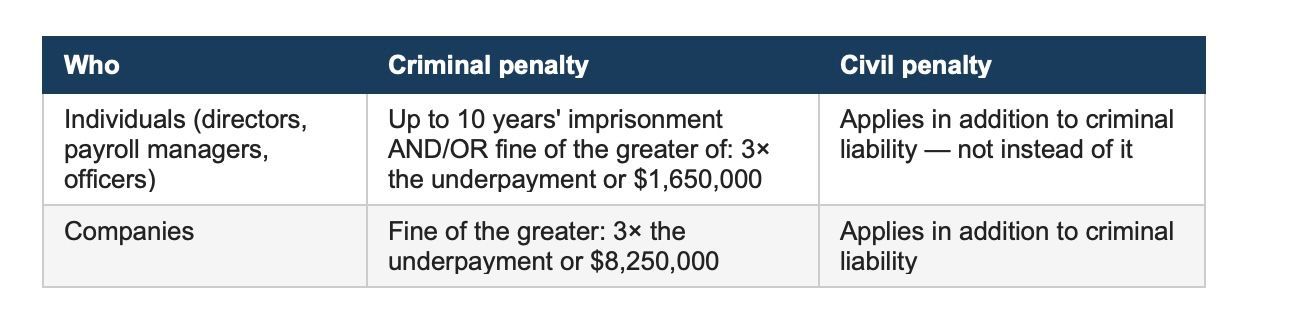
Section 327A of the Fair Work Act 2009 makes intentional underpayment of employee wages and entitlements a criminal offence. The penalties are substantial:
Several important clarifications on scope:
- Honest mistakes remain civil matters, not criminal ones - but the distinction between honest mistake and culpable negligence narrows as tools become more accessible
- Ongoing underpayments that began before 1 January 2025 are captured by the criminal provisions if they continued after that date
- The legislation covers wages, penalty rates, overtime, allowances, superannuation and leave entitlements not just base rates
- Fair Work Inspectors have increased audit activity following the legislation's introduction
The combination of a 4.75% general increase, a 6% increase for C13 and C14 workers, and criminal liability for intentional underpayment fundamentally changes the risk calculus of getting this wrong. 'We used the wrong spreadsheet' is not a defence.
What employers need to do before and after 1 July
Immediate actions - before your first post-1 July pay run
1. Identify every employee covered by a modern award and confirm their classification level. Pay particular attention to any workers at C13 or C14 level — or the equivalent in their relevant award.
2. Apply the correct percentage increase. 4.75% for most award-covered workers. 6% for workers on C13 or C14 rates. Do not apply a flat 4.75% across the board if any of your workforce is on C13 or C14.
3. Check C14 worker tenure. Any C14-classified worker who has been employed for 6 months or more must be reclassified to at least C13 immediately. Create a forward schedule for workers approaching the 6-month mark.
4. Update all rate schedules, quote templates and payroll system configurations before the first full pay period on or after 1 July.
5. Review above-award arrangements. Confirm that your current payments still exceed the new award minimums — particularly for C13-classified workers where the minimum has increased by 6%.
6. Review client contracts for rate escalation provisions. For contracts without them, assess the margin impact of the increase and prioritise those for renegotiation or renewal.
7. Document everything. Record the new rates applied, by classification, the effective date, the source (FWC Annual Wage Review 2026, [2026] FWCFB 3500), and the name of the person who made the update.
Forward planning - for the 2027 and 2028 Annual Wage Reviews
1. Build the C13 phase-out into your commercial planning. Any contract signed post-1 July 2026 that covers C13-classified workers and extends into 2027 should account for Stage 2 of the phase-out — another above-general increase — at the 2027 Annual Wage Review.
2. Mark the 2027 Annual Wage Review in your compliance calendar. The FWC hands down its decision in early June each year, with a 1 July effective date. The timeline is the same every year.
3. Review any contracts that will still be active at the 2028 Annual Wage Review, when C13 is abolished and C12 becomes the new minimum floor. Any pricing that assumed C13 as the base rate will need to be reassessed.
The rate is only as good as the system behind it.
RatesCalc is Australia's only purpose-built wage compliance and quoting platform for recruitment and labour hire. Award rates update automatically after every Fair Work Commission decision. Compliant client quotes in under two minutes. Full audit trail included.
Book a Demo
August 20, 2026
Most businesses treat casual status as a box ticked once, at the start of employment. Write "casual" into the contract, pay the loading, move on. That assumption stopped being safe on 26 August 2024. The Fair Work Act now defines a casual employee by the real substance of the working relationship, not by what the contract says. Two years on, the case law testing exactly what that means in practice has only just started landing, and it's landing against employers who assumed the old rules still applied. Here's what actually changed, what's being tested right now, and what it means if your business places or employs casual workers at scale. The definition changed from "what the contract says" to "what actually happens". Under the new test, a person is a casual employee only if, at the start of employment: the employment relationship has no firm advance commitment to ongoing work, assessed on the real substance and practical reality of the relationship, and they're entitled to a casual loading or specific casual pay rate under an award, agreement, or contract. The Fair Work Ombudsman lists several factors relevant to "firm advance commitment," including whether the employer can offer or withhold work and the employee can accept or reject it, whether further work of that kind is reasonably likely, whether permanent staff perform the same work, and whether there's a regular pattern of work. No single factor decides it. A worker with a predictable roster can still be genuinely casual; a worker with an irregular one can still have a firm advance commitment if the substance of the relationship shows it. Once someone starts as a casual, they stay casual until one of three things happens: they accept an alternative employment offer, they convert under the National Employment Standards, award, or agreement, or a Fair Work Commission order changes their status. Casual conversion is gone. The employee choice pathway replaced it. The old scheme, where employers had to proactively offer conversion after 12 months if certain conditions were met, is fully retired. It remained available only to casuals employed before 26 August 2024, and only in a transitional window that closed on 26 August 2025. Since then, every eligible casual sits under the new employee choice pathway: A casual employed for at least 6 months (12 months at a small business, under 15 employees) who believes they no longer meet the casual definition can give written notice to their employer. The employer must consult with the employee, then respond in writing within 21 days. The employer can only refuse on one of three grounds: the employee still meets the casual definition, fair and reasonable operational grounds, or accepting would breach a required recruitment or selection process. If the notice is accepted, the change takes effect from the first day of the employee's next full pay period, unless both sides agree otherwise. Unresolved disputes go to the Fair Work Commission, which can now arbitrate them, not just conciliate. That's a materially broader power than the old regime had. The first ruling under the new rules just happened in August 2026, and it wasn't in the businesses' favour. In Baker v Macquarie University [2026] FWC 3054, the Commission handed down what it described as the first arbitrated decision to test the employee choice provisions since they commenced. A casual academic who had taught the same subject across consecutive semesters since 2023 gave written notice in November 2025 that he believed he no longer met the casual definition. The university declined. The dispute went to arbitration, and the Commission found in the worker's favour, ordering he be treated as an ongoing part-time employee. Two details from the decision matter more than the headline result. First, the Commission's task was narrow: decide whether the worker actually meets the casual definition in section 15A of the Act. If they do, there's no conversion. If they don't, the employer generally can't keep treating them as casual regardless of preference. Second, the Act requires the Commission to disregard anything that happened after the employee's notice when deciding the dispute. Status is locked in at the moment of notice, not reassessed against whatever the employer does next. An employer can't manage its way out of a notice once it's been given. The Casual Employment Information Statement has a schedule most payroll systems don't track. Separately from the definition change, employers must give every casual the Casual Employment Information Statement (CEIS), alongside the standard Fair Work Information Statement, at set points: Before, or as soon as possible after, the casual starts. Small business employers (under 15 employees): again at the 12-month mark. All other employers: at 6 months, 12 months, and then every 12 months after that. It isn't required more than once in any 12-month period, even with intermittent re-engagement. However, for a business running a large or rotating casual pool, that's a set of dates per worker that a standard onboarding checklist won't naturally catch, because the obligation continues well past onboarding. Sham arrangements are still explicitly illegal. The reforms kept and reinforced existing protections here. It's illegal for an employer to knowingly mislead a current or former permanent employee into a casual contract to do the same work, or to dismiss or threaten to dismiss someone in order to re-engage them as a casual doing the same work. Courts can and do impose penalties for it. The parallel reform: same job, same pay for labour hire. A related but separate 'Closing Loopholes' change affects labour hire specifically. Since the relevant provisions commenced in December 2023, with orders able to take effect from 1 November 2024, labour hire workers, their union, or the host business can apply to the Fair Work Commission for a regulated labour hire arrangement order. Where one applies, labour hire workers must be paid no less than the "protected rate of pay," the rate they'd receive under the host's enterprise agreement if directly employed. The Commission must make the order unless satisfied it isn't fair and reasonable, and there are exclusions for genuine service arrangements and small business hosts. This has moved well past theory. The Mining and Energy Union has secured orders at 30 mine sites covering around 5,000 workers. It isn't confined to mining, either. In a 2026 dispute, the United Workers' Union asked the Commission to determine what a "paid in accordance with this agreement" clause in Electrolux's enterprise agreement required for labour hire workers supplied by Trojan Recruitment Group at Electrolux's Beverley, South Australia site. The union's case was that between October 2022 and October 2025, those workers received only the base hourly rate under the agreement, without the casual loading the clause required. Electrolux directed Trojan to apply the correct rate, without admitting liability, and Deputy President Hampton found the dispute wasn't resolved simply because the rate had since been corrected. He confirmed that "paid in accordance with this agreement" means calculated and paid as if the agreement covered the labour hire workers directly, loading included. That's not a story about a business trying to underpay anyone. It's a story about a pay clause interpreted one way for three years, corrected only after a union raised it, on a site with a host enterprise agreement in place the whole time. What this means in practice. Two questions sit inside these reforms that a manual process is poorly suited to answer: Has a casual quietly earned the right to request conversion? The 6- and 12-month clocks reset per employment relationship and depend on a regular pattern of work that can be easy to lose track of across a large or rotating casual pool, especially when the same worker moves between assignments. Is a placement into a host with an enterprise agreement still being quoted and paid on award rates when a protected rate of pay now applies? That's precisely the fact pattern in the Electrolux dispute; a correctly-drafted contract clause, interpreted incorrectly for years, on a site where the answer was always sitting in the host's own enterprise agreement. Neither is primarily a rate-calculation problem. They're classification and mapping problems, which is a different kind of risk to the wage-increase compliance most businesses are already watching for. RatesCalc keeps a locked, timestamped audit trail against every placement, so questions like these have a documented answer rather than a guess. If you manage a large casual or labour hire workforce and want a clear picture of where your current setup stands, book a 20-minute rate check today. Sources Fair Work Ombudsman, Casual employment changes: fairwork.gov.au/about-us/workplace-laws/legislation-changes/closing-loopholes/casual-employment-changes Fair Work Ombudsman, Becoming a permanent employee: fairwork.gov.au/starting-employment/types-of-employees/casual-employees/becoming-a-permanent-employee Fair Work Ombudsman, Casual Employment Information Statement: fairwork.gov.au/employment-conditions/information-statements/casual-employment-information-statement Fair Work Commission, Periods of service as a casual employee: fwc.gov.au/periods-service-casual-employee Fair Work Ombudsman, Labour hire changes: fairwork.gov.au/about-us/workplace-laws/legislation-changes/closing-loopholes/labour-hire-changes Fair Work Ombudsman, Litigation (current civil penalty amounts): fairwork.gov.au/about-us/compliance-and-enforcement/litigation Baker v Macquarie University [2026] FWC 3054 (12 August 2026), as reported in HCA Mag, Commission orders university to convert casual academic under new choice rules, and Fair Work Legal Advice, Conversion from casual to permanent employment United Workers' Union v Electrolux Home Products Pty Ltd, decision of Deputy President Hampton, Fair Work Commission (27 May 2026), concerning Clause 13 of the Electrolux Home Products Pty Ltd National Logistics Support Centre Enterprise Agreement 2022, as reported in HCA Mag, Fair Work tells Electrolux to ensure labour hire workers get agreement pay Note: the two 2026 Fair Work Commission matters above are cited from contemporaneous legal and HR trade press reporting
July 29, 2026
The Annual Wage Review 2026 decision took effect from the first full pay period on or after 1 July 2026. By now most businesses have run at least two pay cycles under the new rates. The rate change itself is done. This is exactly when underpayments start accruing quietly. The pattern is consistent after every wage review. A business updates the base hourly rate in payroll, confirms the new figure against the Fair Work Commission decision, and considers the job finished. What it hasn't done is check the fifteen or so other numbers that are calculated from that base rate — and those are where the shortfalls sit. Individually they're small. Multiplied across a workforce and left to run for a quarter, they stop being small. If you employ under a modern award, this is the check worth running in the next fortnight, before the error window widens. What actually changed on 1 July The Fair Work Commission handed down its Annual Wage Review 2026 decision on 2 June 2026 ([2026] FWCFB 3500). Two things happened: A 4.75% general increase to all modern award minimum rates. An additional 1.25% structural adjustment for C13 and C14 classifications, forming part of the phased adjustment of the C13 rate. For workers in those classifications, the total movement is 6.00%, not 4.75%. The new C13 rate is $26.44 per hour. The new C14 rate is $25.74 per hour. Around 2.8 million workers are covered, across more than 120 modern awards. That second point is where the first error commonly appears. A single percentage applied uniformly across a rate table will underpay every worker on C13 and C14 rates by 1.25%. On a full-time equivalent, that's a shortfall that compounds across ordinary hours, overtime, leave accruals and superannuation — and it applies to the workers least able to absorb it, which is precisely the profile that attracts regulatory attention. The cascade: what moves when the base rate moves Modern awards are built as a structure of derived rates. Almost nothing in an award is a standalone number. Change the base and the following elements should change with it: 1. Ordinary hourly rate. The obvious one. Usually the only one that gets updated automatically. 2. Casual loading. Typically 25% under most awards, calculated on the new ordinary rate. If your payroll stores casual rates as fixed dollar values rather than as a calculation, they will not have moved. 3. Overtime rates. Time and a half, double time, and any award-specific variants — all calculated on the new base. Check whether overtime is computed dynamically or drawn from a stored rate table. 4. Penalty rates. Weekend, public holiday, evening and early-morning penalties. Same issue: dynamic calculation versus stored values. 5. Shift loadings. Afternoon, night, permanent night and rotating shift loadings, each with its own percentage under the relevant award. 6. Casual overtime and casual penalties. The compounding question — whether loading and penalty are calculated on the base or on the loaded rate — varies by award. If you got this wrong before 1 July, the increase has now magnified the error. 7. Annual leave loading. Usually 17.5% of the ordinary rate, so it moves with the base. 8. Percentage-based classifications. Junior rates, apprentice rates and trainee rates are expressed as a percentage of an adult classification rate. They move automatically only if your system holds them as percentages. 9. Higher duties and mixed-function rates. Where an employee performs work at a higher classification for part of a shift. 10. Superannuation. The superannuation guarantee is calculated on ordinary time earnings. A higher ordinary rate means a higher SG obligation. An underpaid wage produces an underpaid super contribution, which is a separate liability with its own consequences. 11. Notice, redundancy and termination payments. Calculated on the applicable rate at the time of termination. 12. Annualised wage arrangements and salary set-offs. Where an award permits an annualised salary in satisfaction of award entitlements, the arrangement must still leave the employee no worse off. A 4.75% movement in the underlying rates can push a previously compliant salary below the required outer limits. This one is routinely missed because the salary figure itself doesn't change — so nothing appears to have happened. 13. Enterprise agreement rates. An EA cannot pay less than the relevant award minimum. Where EA rates were set with a modest buffer above the award, an increase of this size can erode or eliminate that buffer. The allowance trap Allowances need separate handling, and this is where a well-intentioned bulk update creates a problem. Awards contain two broad categories of allowance: Wage-related allowances — leading hand, first aid, industry allowances, and similar — are typically expressed as a percentage of a standard rate and move with the wage increase. Expense-related allowances — meal, travel, tool, vehicle and laundry allowances — are generally adjusted by reference to the relevant Consumer Price Index figures, not by the annual percentage increase. Applying 4.75% across every allowance line is not a conservative safe harbour. It produces incorrect figures, breaks your reconciliation, and makes it harder to demonstrate that you calculated anything deliberately. Each allowance needs to be taken from the current award text. Where the errors actually originate In practice, post-review underpayments come from four places. Payroll configuration . Systems that store derived rates as static values rather than calculating them from the base. The base updates; the derived rates don't. Nothing errors, nothing flags, and payslips look normal. Rate spreadsheets . The parallel set of numbers that operations and account managers actually work from. Payroll gets updated on time; the spreadsheet in the shared drive doesn't, and it's the spreadsheet that drives quoting and client rate cards. Client rate cards and contracts. For agencies, this is the commercial version of the same problem. The pay rate goes up on 1 July; the charge rate agreed with the host doesn't move until someone renegotiates it. That's a margin problem rather than a compliance problem — but it becomes a compliance problem when someone under pressure decides to hold the pay rate down to protect the margin. Classification drift. A worker's duties change and the classification doesn't follow. The wage review makes this worse, because the gap between the classification you're paying and the classification you should be paying widens with every increase. The check to run this fortnight Work through this against a sample of at least five employees, chosen to cover casual, permanent, shift-working and overtime-working profiles: Confirm the base rate against the current award text — not a summary, not a secondary source. Fair Work's pay tools and the award itself are the source. Confirm C13 and C14 workers received 6.00%, not 4.75%. Recalculate one overtime shift, one weekend shift and one public holiday shift manually and compare against what was actually paid. Check casual loading is calculated on the new ordinary rate. Check every allowance line against the current award — separating wage-related from expense-related. Recalculate superannuation on the corrected ordinary time earnings. For anyone on an annualised salary, run the reconciliation against the new award rates rather than assuming last year's outcome still holds. Confirm any enterprise agreement rates still sit above the new award minimums. If any of those checks produces a variance, the important question isn't just how much — it's how far back, and whether the same error affects everyone in that classification. If you find a shortfall Move quickly and document what you do. Calculate the full amount owed, including superannuation. Back-pay it immediately. Keep a written record of what the error was, when it was identified, how it was calculated and when it was rectified. That record matters more than employers tend to realise. Since 1 January 2025, intentional underpayment of wages can be a criminal offence. Honest mistakes are not captured by that offence — but the distinction between an honest mistake and something else is drawn on evidence, and the evidence is your documentation and your process. An error found by your own review and fixed within a pay cycle looks materially different from the same error found by an inspector two years later with no record of anyone having looked. The underlying issue Most businesses aren't getting this wrong through carelessness. They're getting it wrong because award interpretation is genuinely difficult, the derived rates are numerous, and the tools most agencies use — payroll systems built for a single employer, and spreadsheets built by someone who has since left — were never designed to hold 120-plus awards and re-derive every dependent rate when the base moves. That's the problem RatesCalc was built for. Award rates update automatically at the source, every derived rate recalculates from the current award text, and every rate decision carries a timestamped record of what was applied and when. Run a post-1 July rate check.
July 11, 2025
Are you as profitable as you think? Discover the silent margin erosion affecting recruitment businesses — and what to do about it.